
28 KiB
Taking Notes with Org
A literate programming file for configuring Emacs to take notes.
Introduction
Seems silly to have a full set of instructions for taking notes using Org-mode, because that is what it does, but this is a bit special.
When I capture notes with a link to some source code, the destination is a clocked in task. Useful, but seems to require a dedicated task and some forethought. The following project pairs a “source code file” (which can be any file, actually) and a “notes file” with headers based on the function in the original file.
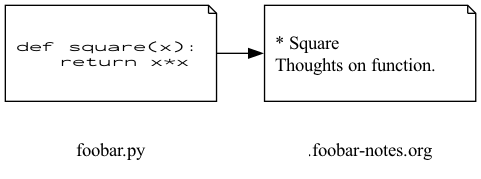
This allows me to wax poetic with a parallel, but separate org file. Of course, this requires adding the following to every project’s .gitignore file (or in your HOME directory).
/.*-notes.org
If this isn’t good for you, check out Montag. Same project, different approach using a single directory for all notes with org-roam.
Let’s create a pattern for what a notes file is, and how to recognize them:
  (defconst ha-code-notes-rx (rx (optional "/")
                                 "." (one-or-more (not "/")) "-notes.org" string-end))

  (defun ha-code-notes-file (file &optional parent)
    "Return a FILE's 'code notes' filename.
    Prepend the PARENT if given."
    (cond
     ((and parent (string-match-p (rx "/" string-end) parent))
             (format "%s.%s-notes.org" parent file))
     (parent (format "%s/.%s-notes.org" parent file))
     (t      (format ".%s-notes.org" file))))
Another feature when looking at the notes in the org buffer, is to hit the same key to return to the source code file referencing the notes.
Helper Functions
While this project started simple, I’ve expanded the ideas, and this requires some custom helper functions.
Relative Code Locations
Creating a note based on the filename, should be easy, but what if I made the header’s in this file reference a location in the original source code. For instance:
foo.py               .foo-notes.org
------               ------------------

def square(x):   →   * Square
  return x*x         Notes about the function
We could store the line number as an Org Property of the foobar header, but this would get out of sync as the foo.py source code changed.
What we want is to store the function name as an Org Property, and some sort of offset from the function name. For instance:
  foo.py                          .foo-notes.org
  ------                          ------------------

  def square(x):              →   * Square
    "Return the square of x."     :PROPERTIES:
    return x*x                    :XREF_NAME: square
                                  :XREF_OFFSET: 2
                                  :END:
                                  Notes about the function
My immediate thought was to tie into the xref module for Emacs, but it doesn’t have a query function about what function or class/method the point is in. The following functions take advantage of which-function and imenu to programmatically give me relative location and a -goto to return to that location.
This was far gnarlier than I originally thought, since IMenu only wants to interactively walk down a tree, specifically the top-level class, then the methods inside that class, and even to the parameters of the method.
  (defun ha-code-notes-location ()
    "Return point location relative from its nearest enclosing definition.
  Can use later, even if intervening lines shift.

  Returns a list for `ha-code-location-goto' to use, suitable for
  `seq-let':

    (file qualified-name offset)"
    (let* ((here  (point))
           (entry (ignore-errors
                    (thread-last (imenu--make-index-alist t)
                                 ;; Flatten hierarchy labels with dot separators:
                                 (ha-code-notes-location--flatten-index)
                                 ;; Filter to only entries that occur after point:
                                 (seq-filter (lambda (e) (<= (cdr e) here)))
                                 ;; Sort the remaining entries by position
                                 ;; (since out flatten-index function
                                 ;; doesn't guarantee the order):
                                 (seq-sort-by #'cdr #'>)
                                 ;; And the first entry on the list is our goal:
                                 car))))
      (unless entry
        (error "No enclosing definition found for point"))
      (list (buffer-file-name)
            (car entry)
            (- (line-number-at-pos here) (line-number-at-pos (cdr entry))))))
The needed trick is to flatten this IMenu hierarchy using this recursive beauty:
  (defun ha-code-notes-location--flatten-index (alist &optional prefix)
    "Flatten imenu ALIST into a list of (NAME . POSITION).
  Where the name matches what which-function/imenu expect.

  For instance:

     (((\"foo_class\") (\"method_one\") (\"method_two\") ...) ...)

  To:

     ((\"foo_class.method_one\" ...) (\"foo_class.method_two\" ...)...)

  Called recursively, where PREFIX could be a class name, or other higher
  abstraction when the nesting represents a real outline (Org, Markdown).

  Entries tagged with `imenu-kind' or `breadcrumb-kind' property (as Eglot
  nests a function's local variables for Python) are already a flat
  namespace of functions/variables/constants, so their own names are kept
  bare and not qualified by an enclosing function's name."
    (mapcan
     (lambda (entry)
       (unless (or (null entry) (atom entry))
         (let* ((raw-name (car entry))
                (kind (and (stringp raw-name)
                           (or (get-text-property 0 'imenu-kind raw-name)
                               (get-text-property 0 'breadcrumb-kind raw-name))))
                (name (if (stringp raw-name)
                          (replace-regexp-in-string
                           (rx space "(" (one-or-more alpha) ")" string-end)
                           "" (substring-no-properties raw-name))
                        (format "%s" raw-name)))
                (value (cdr entry))
                (qualified (if (and prefix (not kind)) (format "%s.%s" prefix name) name)))
           (cond
            ;; Case 1: Nested submenu (list of alist entries). Eglot
            ;; never gives the container itself a position among its
            ;; children, as Org does; it stashes it in the
            ;; `imenu-region' text property instead, so recover it
            ;; here. Children only inherit QUALIFIED as their prefix
            ;; when this entry has no `imenu-kind' of its own -- i.e.
            ;; when the nesting is a real outline, not Eglot's flat
            ;; function/variable/constant tagging.
            ((and (listp value) (consp (car value)))
             (append
              (let ((region (and (stringp raw-name)
                                  (get-text-property 0 'imenu-region raw-name))))
                (when region (list (cons qualified (car region)))))
              (ha-code-notes-location--flatten-index value (unless kind qualified))))

            ;; Case 2: Direct marker or integer position
            ((integer-or-marker-p value)
             (list (cons qualified (if (markerp value) (marker-position value) value))))

            ;; Case 3: Overlay or element containing a position in car/cdr
            ((overlayp value)
             (list (cons qualified (overlay-start value))))

            ((and (consp value) (integer-or-marker-p (car value)))
             (list (cons qualified (if (markerp (car value))
                                       (marker-position (car value))
                                     (car value)))))

            ;; Fallback: ignore non-positional Imenu metadata entries
            (t nil)))))
     alist))
This flatten feature has been a pain in my side. An org-mode formatted file works well, for instance, running the following on this document:
(ha-code-notes-location--flatten-index (imenu--make-index-alist t))((*Rescan* . -99) (Introduction . 946) (Helper Functions.Relative Code Locations . 3719) (Helper Functions.Org Properties . 13220) (Helper Functions . 3592) (Write a Note.Return to Source Code . 22408) (Write a Note.Fringe Indicators for Notes . 24001) (Write a Note . 17005) (Technical Artifacts . 27464))
But running the same expression on a Python file (via Eglot) nests the local variables and parameters of each function as children in the index, each tagged with an imenu-kind text property on its name, e.g. a function like this:
(#("parse_args" 0 10 (imenu-region (1245 . 1627) imenu-kind "Function" breadcrumb-region (1245 . 1627) breadcrumb-kind "Function"))
 (#("argv" 0 4 (imenu-region (1260 . 1289) imenu-kind "Variable" ...)) . 1260)
 (#("parser" 0 6 (imenu-region (1365 . 1371) imenu-kind "Variable" ...)) . 1365))
Naively flattening this treats argv and parser as if they were nested methods, producing useless entries like parse_args.argv. Worse, the function itself never had its own position among its children (unlike Org, which gives a parent headline a self-pointing entry), so there was no way to jump straight to parse_args at all.
The fix: the presence of an imenu-kind=/=breadcrumb-kind property means the nesting is Eglot's flat function/variable/constant tagging, not a real outline – so a child's name is never qualified by its parent's. When recursing into a nested submenu, the container's own position is recovered from its imenu-region text property, and the name is stripped of text properties. That turns the above into clean, bare entries for every name – function, variable, and constant alike:
((parse_args . 1245) (argv . 1260) (parser . 1365) (registry_credentials . 1630) ...)
Once inside a source file, we can jump to one of these relative locations:
  (defun ha-code-notes-location-goto (file name offset)
    "Move point to the position described by relative location.

    FILE is the filename to load, may be nil to use current buffer.
    NAME is a function name or other definition, e.g. ClassName.method
    OFFSET is the number of lines below NAME to position the point."
    (when (and file (not (equal file (buffer-file-name))))
      (find-file-other-window file))

    (condition-case t
        (ha-code-notes--location-goto name offset)
      (message "Definition `%s' no longer found in %s" name file))

    (ignore-errors
      ))

  (defun ha-code-notes--location-goto (name &optional offset)
    "Use `imenu' interface to goto NAME location.
  If OFFSET given, move that many lines below."
    (let* ((index (ha-code-notes-location--flatten-index (imenu--make-index-alist t)))
           (entry (assoc name index)))
      (when entry
        (goto-char (cdr entry))
        (when offset
            (forward-line offset)))))
To verify that this works:
  (seq-let (file heading offset) (ha-code-notes-location)
    (ha-code-notes-location-goto file heading offset))
The cool part of these functions is that this works in Org and Markdown files too!
Org Properties
The org-set-property will set a key/value pair in the :PROPERTIES: section of the current section, but I want to add a buffer-level property to an org-mode file, for instance:
  #+TITLE: The title of the file
  #+PROPERTY: key1 value1
The tricky bit about this function is that if (in the above example) key1 exists, we should replace it, not add to it.
  (defun org-set-buffer-property (key value)
    "Set a buffer-level property at the top of an Org file.
  If KEY already refers to a #+PROPERTY, replace it.
  Otherwise, insert it at the end of the Org header lines."
    (let ((property-line (format "#+PROPERTY: %s %s" key value))
          (magic-re (rx  (group line-start "#+PROPERTY:"
                                    (one-or-more space) (literal key) (one-or-more space)
                                    (zero-or-more any)
                                    line-end))))
      (save-excursion
        (goto-char (point-min))
        (while (cond
                ((looking-at magic-re) (replace-match property-line t t))
                ((looking-at "#")      (forward-line))
                (t                     (insert property-line ?\n)))))))
Note: The while loop above has no body, as the cond is the predicate as it returns non-nil if it has more to process. This works because replace-match and insert return nil, while forward-line returns a non-nil value.
The function, org-entry-get, returns the value of a property of the current heading, and will walk up to parent sections too when passed a non-nil INHERIT argument. That handles everything except the buffer-level default set via #+PROPERTY:, which isn't attached to any heading, so we need a fallback for that case.
And we need the ability to read it. The Org API doesn’t have a function to read it without parsing the entire structure, so we use the org-collect-keywords for the PROPERTY value, and then parse the results.
  (defun org-get-property (property)
    "Return the value of the Org PROPERTY.
  Works even if the property is set in a parent section.
  Return nil if the property is not found."

    (defun org-get-buffer-property (property)
      "Helper function that reads the current PROPERTY set in the buffer."
      (when-let* ((properties (thread-last "PROPERTY"
                                           (list)  ; Requires a list of keywords
                                           (org-collect-keywords)
                                           (car)   ; A list of lists? Get first entry
                                           (cdr))) ; Remove the `PROPERTY' element

                  ;; See if property matches the key in a "key value" pair:
                  (find-property-p (lambda (kv) (string= property (car (split-string kv)))))

                  ;; Each entry in properties is a string with the key and value:
                  (entry (seq-find find-property-p properties)))
        (substring entry (1+ (string-search " " entry)))))

    ;; Check the entry at point (and its ancestors) first; only look
    ;; for a buffer-level default if neither has it set:
    (or (org-entry-get nil property t)
        (org-get-buffer-property property)))
These two work like:
  (org-set-buffer-property "foo" "bar")
  (org-get-property "foo")  ; ⟹ "bar"

  ;; Reset the value:
  (org-set-buffer-property "foo" "baz")
  (org-get-property "foo")  ; ⟹ "baz"

  ;; Over shadow the global property with local one:
  (org-set-property "foo" "boo")
  (org-get-property "foo")  ; ⟹ "boo"

  ;; And remove it:
  (org-delete-property "foo")
  (org-get-property "foo")  ; ⟹ "baz"
Write a Note
This function defines what the notes filename should look like, loads it in a side window, and adds a back reference in the form of an org-mode property. Next it needs to either find the section that matches the function in the code we are writing about, or jumps to the bottom and creates it.
  (require 'which-func)

  (defun ha-code-notes ()
    "Open an Org file based on the current opened file.
  The pattern for choosing the name of the org file is:

     foobar.py --> .foobar-notes.org

  The Org header will be the name of the function in the original source
  code file. This means you have one note section per function, which
  should be fine in practice because functions are small and succinct,
  right?"
    (interactive)
    (let* ((orig-file   (buffer-file-name))
           (orig-parent (file-name-directory orig-file))
           (orig-base   (file-name-base orig-file))

           ;; Keep in mind the `orig-parent' has a final slash, so the
           ;; initial . here marks it as hidden:
           (note-file   (ha-code-notes-file orig-base orig-parent))
           (header      (which-function))
           (offset      (ha-code-notes-defun-rel-line)))

      ;; With the above local variables defined, we can open the file in
      ;; a window (pane) to the side:
      (find-file-other-window note-file)
      (org-set-buffer-property "XREF" orig-file)

      ;; Create a new section in the notes file:
      (ha-code-notes-insert-heading header offset)

      ;; (when-let ((buf (find-buffer-visiting orig-file)))
      ;;   (with-current-buffer buf
      ;;     (ha-code-notes--fringe)))
      ))
Use the builtin autoinsert feature to inject a basic template at the beginning of the notes file when we first create the notes file:
    (use-package autoinsert
      :config
      (define-auto-insert
        (cons ha-code-notes-rx "Org Notes Template")
         '("Short description: "
           "#+TITLE: "
           (s-titleized-words (s-replace-regexp (rx (any "-" "_")) " "
                                               (file-name-base (buffer-file-name))))
           \n
           "#+DATE:"   (format-time-string "%Y-%m-%d %a")
           \n
           "#+LASTMOD:" (format-time-string "[%Y-%m-%d %a]")
           \n \n)))
What is the offset?
  (defun ha-code-notes-defun-rel-line ()
    "Return the number of lines between point and the start of the current defun."
    (let ((orig-line (line-number-at-pos)))
      (save-excursion
        (if (provided-mode-derived-p major-mode '(text-mode))
            (org-previous-visible-heading 1)
          (beginning-of-defun))
        (- orig-line (line-number-at-pos)))))
If a heading matching the function already exists, we add a new subheading under it to record this particular visit. The real purpose of this, is to store a relative line number to another section of the function. Its title is left blank, so we hand off to the user to name it, then jump to the body once they press RET or TAB:
  (defun ha-code-notes-insert-heading (header offset)
    "Insert heading recording OFFSET under heading matching HEADER.

    Finds the top-level Org heading whose `XREF_NAME' property equals
    HEADER. If none exists, inserts one at the end of the buffer.
    Otherwise, looks inside that heading's subtree for an entry whose
    `XREF_LINE' property already equals OFFSET: if found, this visit
    was already recorded, so we jump to its body instead of inserting
    a duplicate. Otherwise, inserts a new level-2 subheading at the
    end of the section.

    Before inserting a new subheading, it will prompt for the value."
    (goto-char (point-min))
    (let ((top-level (org-find-property "XREF_NAME" header)))
      (if (not top-level)
          ;; No section for this function yet: create one at the end.
          (progn
            (goto-char (point-max))
            (ha-code-notes--insert-heading header offset 1))

        ;; Found the function's section; look inside it for this
        ;; exact visit before deciding to insert a new subheading.
        (goto-char top-level)
        (let ((visit (save-excursion
                       (save-restriction
                         (org-narrow-to-subtree)
                         (org-find-property "XREF_LINE" (number-to-string offset))))))
          (if visit
              (progn (goto-char visit) (org-end-of-subtree))
            (ha-code-notes--insert-heading "" offset 2))))))
The above function require this helper function to insert the initial text of the section and its header:
  (defun ha-code-notes--insert-heading (header offset level)
    "Insert a section with headline, HEADER."
    (when-let ((section-label (read-string "Section header: " header)))
      ;; Make sure our new heading is at the end of current section:
      (org-insert-heading '(4) nil level)
      (insert (format "%s" section-label))

      (org-insert-property-drawer)
      ;; In case we want to change the section header name, we store
      ;; the name of the function that led us here as a property:
      (when (= level 1)
        (org-set-property "XREF_NAME" header))
      (org-set-property "XREF_LINE" (number-to-string offset))
      (org-end-of-subtree)))
Return to Source Code
If we are inside one of these note files, let’s have a quick way to return back to the original “code” file:
  (defun ha-code-notes-return ()
    "Return to the code referenced in the notes.
  Essentially pretends we have a backlink without a database. Reads
  XREF_LINE and XREF_NAME off the entry containing point, rather than
  just the first match anywhere in the buffer, so returning from a
  subheading lands on the line for that particular visit."
    (interactive)
    (let* ((filename (org-get-property "XREF"))
           (f-offset (when-let ((line (org-entry-get nil "XREF_LINE")))
                       (string-to-number line)))
           (function (or (org-entry-get nil "XREF_NAME" t) (which-function))))

      ;; If the property is set, load that file (which jumps to the
      ;; buffer if it is displayed), otherwise, we assume the previous
      ;; buffer contains it:
      (if filename
          (find-file-other-window filename)
        (switch-to-prev-buffer))

     (ha-code-notes-location-goto filename function f-offset)))
And give us keybinding that will either go to the notes (if we are in some code) or return to the source code (if we are in our notes):
  (defun ha-code-notes-dwim ()
    "Open the notes buffer, or return to the code."
    (interactive)
    (when (buffer-file-name)
      (if (string-match ha-code-notes-rx (buffer-file-name))
          (ha-code-notes-return)
        (ha-code-notes))))

  (ha-leader "n c" '("code notes" . ha-code-notes-dwim))
Fringe Indicators for Notes
A code file with an associated notes file is easy to forget about. Let's mark, in the fringe, every line that has a note, so we notice it as we scroll past:
  (define-fringe-bitmap 'ha-code-notes-bitmap
    [#b00001100
     #b00010110
     #b00010111
     #b00101110
     #b00101110
     #b01011100
     #b01011100
     #b10110000
     #b10010000
     #b11100000]
    nil nil 'center)

  (defface ha-code-notes-face
    '((t :foreground "yellow"))
    "Face for the fringe marker indicating a line has an associated note.")

  (defvar-local ha-code-notes--fringe-overlays nil
    "Overlays marking lines in this buffer that have notes in the paired notes file.")

  (defun ha-code-notes--fringe ()
    "Mark, in the fringe, every line in this buffer that has a note.
    Notes live in the paired `.BASE-notes.org' file (see
    `ha-code-notes') as headings whose XREF property matches this
    file, XREF_NAME names the function (inherited by subheadings from
    their parent), and XREF_LINE is a line offset from that function's
    start, computed by `ha-code-notes-defun-rel-line'. We resolve each
    pair back to an absolute line via `ha-code-notes-location-goto', since the function
    may have moved since the note was taken."
    (mapc #'delete-overlay ha-code-notes--fringe-overlays)

    (setq ha-code-notes--fringe-overlays nil)
    (let* ((orig-file (buffer-file-name))
           (note-file (and orig-file
                           (ha-code-notes-file
                            (file-name-directory orig-file)
                            (file-name-base orig-file))))
           notes)
      ;; Only run if this is an actual file AND its notes file exists:
      (when (and orig-file
                 note-file
                 (file-exists-p note-file)
                 (not (string-match-p ha-code-notes-rx orig-file)))
        (with-temp-buffer
          (insert-file-contents note-file)
          (org-mode)
          (org-map-entries
           (lambda ()
             (when (equal (org-get-property "XREF") orig-file)
               (when-let ((line (org-entry-get nil "XREF_LINE")))
                 (push (cons (org-entry-get nil "XREF_NAME" t)
                             (string-to-number line))
                       notes))))))
        (dolist (note notes)
          (save-excursion
            (ha-code-notes-location-goto nil (car note) (cdr note))
            (let ((ov (make-overlay (point) (point))))
              (overlay-put ov 'before-string
                           (propertize "x" 'display
                                       '(left-fringe ha-code-notes-bitmap
                                                     ha-code-notes-face)))
              (push ov ha-code-notes--fringe-overlays)))))))

  (add-hook 'find-file-hook #'ha-code-notes--fringe)
New notes and edited notes should refresh the markers too, so we hook into saving a notes file, and refresh right after inserting a new XREF property drawer:
  (defun ha-code-notes--fringe-notes-refresh-all ()
    "Refresh fringe note markers in every buffer after saving a notes file."
    (when (string-match ha-code-notes-rx (buffer-file-name))
      (dolist (buf (buffer-list))
        (with-current-buffer buf
          (when buffer-file-name
            (ha-code-notes--fringe))))))

  (add-hook 'after-save-hook #'ha-code-notes--fringe-notes-refresh-all)